

Ethylene-propylene Copolymer (OCP J0010) from China
Leave a message
Ethylene Propylene Copolymer is a kind of Olefin Copolymer (OCP), the current olefin copolymer generally refers to the ethylene-propylene copolymer viscosity index improver (OCP VII). Due to its high thickening effect and relatively low price, OCP occupies a large share of the engine lube VII market.
Chorus Lubricant Additive Company offers OCP (Olefin Copolymer) Viscosity Index Improver. Please contact us for the OCP price and a sample to evaluate the performance.
OCP is made of ethylene and propylene as raw materials, using vanadium as the catalyst, using hydrogen or ethyl trichloroacetate to adjust molecular weight, and direct polymerization.
In the production process, the proportion of ethylene and propylene in the polymer should be appropriate, which directly affects the performance of the product.
If the content of ethylene is too high, the viscosity index is high, the crystallinity of the polymer increases, the oil solubility of the product becomes poor, and the low temperature is easy to form gel. In order to improve the crystallinity of ethylene polymer, propylene copolymerization is needed.
If the content of propylene is too high, the side chain of the polymer will increase, and the number of carbon on the main chain will decrease, which will reduce the viscidity and oxidation stability.
The reaction formula for the synthesis of ethylene-propylene copolymer

The solid OCP viscosity index improver must be dissolved in the base oil before it was blended with the base oil and other additives.
For this reason, it must first be cut into small particles and then added to high-quality diluent oil at a temperature of 100~130°C, and stirred continuously, and the viscosity of the oil is continuously increased during the dissolution process.
At present, the SSI of OCP is required to be around 25% internationally. In order to meet this requirement, the relative molecular weight of OCP must be reduced, and the thickening ability will also decrease accordingly, and the dosage will increase. The increase of dosage not only deteriorates the detergency of lubricating oil, but also deteriorates the low-temperature performance.
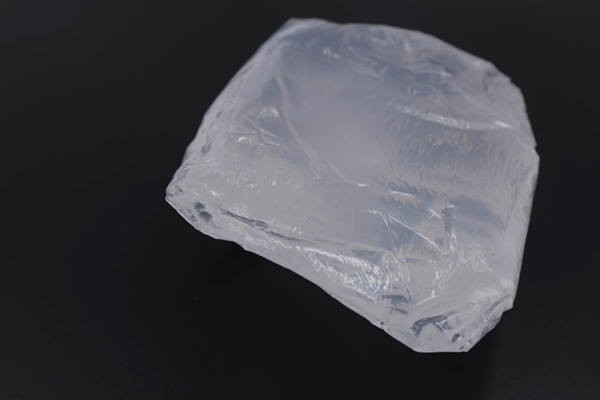
Olefin Copolymer Viscosity Modifiers OCP J0010
Comparative analysis of Olefin Copolymer Viscosity Modifiers (OCP VM) J-0010 and International products
Molecular weight and distribution
The characterization methods of viscosity index agent molecular weight include number-average molecular weight(Mn) and weight-average molecular weight(Mw), which are statistical data.
The ratio of weight-average molecular weight to number-average molecular weight is called molecular weight distribution(MWD);
MWD=Mw/Mn
The molecular weight affects the thickening ability and shear stability (SI) of viscosity index improver The greater the molecular weight, the higher the thickening ability, but the poorer the SI; the wider the molecular weight distribution, the greater the difference in molecular weight in the viscosity index improver, and the worse the SI.
|
Sample Number |
Mn |
Mw |
Mw / Mn |
|
OCP Competitor |
77606 |
153836 |
1.98 |
|
88757 |
170565 |
1.92 |
|
|
OCP J-0010 |
76741 |
141591 |
1.85 |
|
77387 |
150720 |
1.95 |
|
|
83587 |
156116 |
1.87 |
Molecular weight and distribution comparison
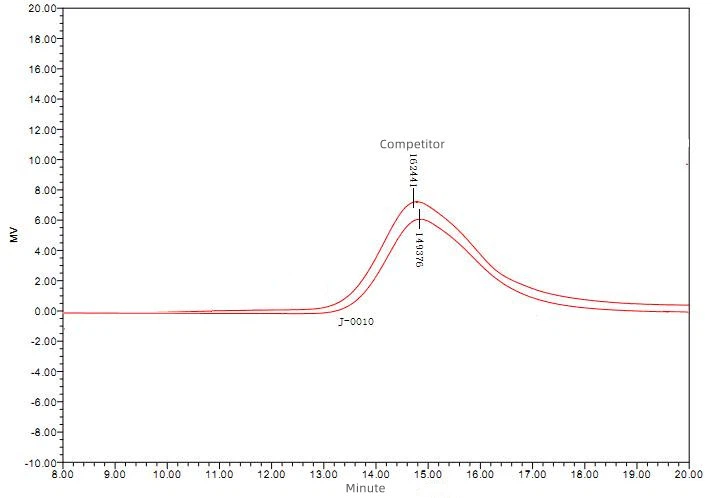
Summary: As per the above data in the figure and table, the molecular weight and molecular weight distribution MWD of OCP J-0010 are close to the foreign competitor product.
Comparative analysis of composition
OCP viscosity index improvers are copolymerized by ethylene and propylene. It is generally believed that in ethylene-propylene copolymer (random), when the ethylene content exceeds 60% (Wt%), it will crystallize, and this will affect the solubility.
|
Sample |
Batch Number |
Content by Wt |
|
|
P |
E |
||
|
Competitor |
2017.3.15 |
54.80% |
45.20% |
|
2017.4.27 |
55.20% |
44.80% |
|
|
J-0010 |
2015.1.17 14:34 |
47.80% |
52.20% |
|
2015.1.18 6:07 |
48.30% |
51.70% |
|
|
2015.1.16 0:05 |
48.00% |
52.00% |
|
Summary: The ethylene content of J-0010 is slightly different from that of foreign products. Both of them are in the range of non-crystalline state. They are amorphous polymers with similar solubility.
Structural Analysis
The sequence structure mainly characterizes the bonding mode of the structural units in the copolymer, such as E-E, P-E, etc. The bonding mode affects the order of the copolymer.
It is generally believed that if the number of ethylene units reaches 8 to 10 in a row, microcrystals may be produced, and if the number of ethylene units reaches 15 in a row, crystallization will occur. The appearance of crystallization will affect the oil solubility of the polymer.
|
Sample |
Batch Number |
Binary sequence molar distribution |
Ternary sequence molar distribution |
||||||||
|
PP |
PP* |
PE |
EE |
PEP |
PEE |
EEE |
EPE |
PPE |
PPP |
||
|
Competitor |
2017.3.15 |
11.90% |
0.30% |
50.00% |
37.80% |
10.60% |
29.10% |
23.00% |
18.20% |
13.90% |
5.10% |
|
2017.4.27 |
12.90% |
0.40% |
49.70% |
37.00% |
10.30% |
29.70% |
21.90% |
18.10% |
14.20% |
5.90% |
|
|
J-0010 |
2015.1.17 14:34 |
4.10% |
1.70% |
46.90% |
47.30% |
6.30% |
34.10% |
32.10% |
21.10% |
4.60% |
1.80% |
|
2015.1.18 6:07 |
3.00% |
2.00% |
45.80% |
49.20% |
5.90% |
33.60% |
34.70% |
21.80% |
2.00% |
2.00% |
|
|
2015.1.16 0:05 |
6.30% |
2.50% |
50.20% |
41.00% |
8.10% |
34.40% |
25.90% |
21.60% |
7.40% |
2.70% |
|
Summary: Compared with foreign products, OCP J-0010 has a different sequence structure. Foreign products have relatively high propylene content, which is reflected in the relatively long binary and ternary sequences of propylene.
Structural comparison
H NMR Spectrum Comparison (OCP J0010 - Red)
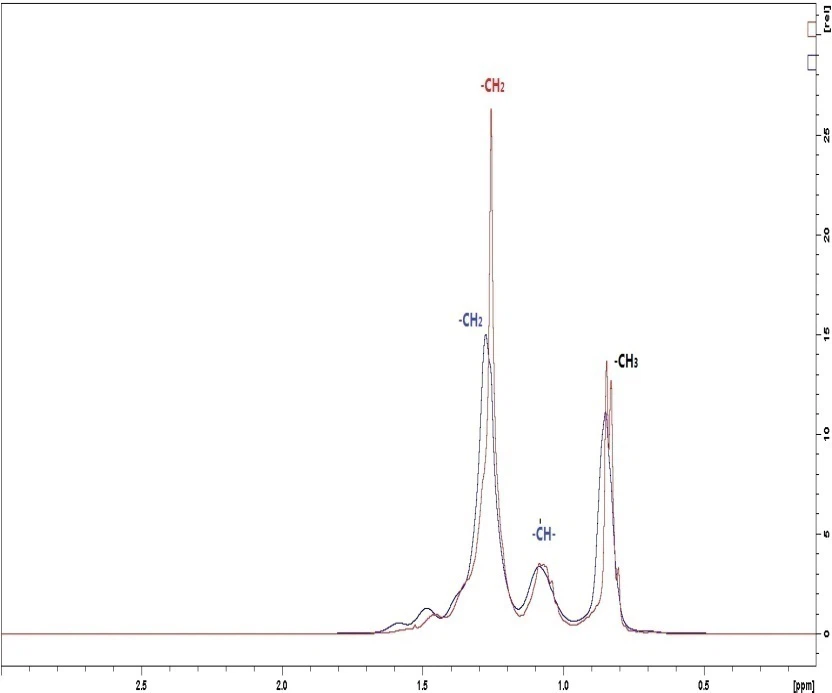
C NMR ( OCP J0010 - Red)

Summary: J-0010 has different ethylene content and sequence structure than foreign products, but there is no difference in oil solubility.
Storage Stability Comparison under different temperature
The viscosity index improver is dissolved in the oil. During the storage, with the time and the of temperature change, there may be precipitation, which will affect the performance of the lubricant.
|
Precipitate |
Competitor |
OCP J-0010 |
||||
|
Low Temperature |
Roon |
High |
Low Temperature |
Roon |
High |
|
|
Formosa Plastics |
no precipitation |
clear & transparent |
no sediment |
no precipitation |
clear & transparent |
no sediment |
|
Huizhou |
no precipitation |
clear & transparent |
no sediment |
no precipitation |
clear & transparent |
no sediment |
|
Daqing |
no precipitation |
clear & transparent |
no sediment |
no precipitation |
clear & transparent |
no sediment |
|
Note: Store at low temperature -10°C for 96 hours; store at high temperature 100°C for 240 hours; store at room temperature for 120 hours. |
||||||
Summary: OCP J-0010 and foreign products have better storage stability under different temperature in Group II and Group III base oil 150N.
Thickening Ability Comparison
Thickening ability is a very important property of viscosity index improver (VII). The greater the Thickening ability of the VII, the smaller the treat rate and the lower the cost of the multi-grade oil. The thickening ability is mainly related to the molecular weight of the VII, and the kinematic viscosity at 10% dosage directly reflects the thickening ability of the OCP VII.
|
Sample |
Thickening Ability(mm2/s) |
|||||
|
J-0010 |
4.79 |
4.82 |
4.75 |
4.64 |
4.65 |
4.73 |
|
Competitor |
4.8 |
4.82 |
4.74 |
4.75 |
4.78 |
4.79 |
Summary: Under the condition of 10% dosage of OCP J-0010 and foreign OCP products, the average value of kinematic viscosity and thickening ability is basically the same.
Kinematic Viscosity Comparison of Viscosity Index Improvers OCP
Comparative Analysis of Kinematic ViscosityJ0010 ( 10% Dosage)
When the viscosity index improver blends into the lubricating oil, the base oil is usually heated to a specific temperature, and then put into ethylene propylene VII (cut into small pieces)
The better the stability of kinematic viscosity (10%), the easier the blending process of lubricating oil; otherwise, the kinematic viscosity (10%) fluctuates greatly, and technicians need to constantly adjust the formula, it prolong the blending time of lubricating oil. Increase the workload of technicians and increase the production cost of lubricating oil.
|
ITEM |
10% KV(mm2/s) |
|
OCP J-0010 |
603.5 |
|
624.4 |
|
|
601.8 |
|
|
571.6 |
|
|
568.7 |
|
|
586.2 |
|
|
OCP Competitor |
600.9 |
|
590.8 |
|
|
582.8 |
|
|
602.1 |
|
|
605.4 |
|
|
602.4 |
Summary: The Kinematic Viscosity (10%) fluctuation range of J-0010 and foreign products is both small, it is easy and simple for the lube oil blending manufacturer to control the production process.
Comparison of Shear Stability of Viscosity Index Improvers OCP
The shear stability of lubricating oil represents the property that the lubricating oil can maintain a stable viscosity when subjected to mechanical shear.
If the shear stability is good, the lubricating oil can maintain a relatively stable viscosity during mechanical shear. Otherwise, the viscosity is reduced due to shearing (the engine oil becomes thinner), which affects the service life of the lubricating oil.
|
ITEM |
Shear Stability Index (SSI) |
|
OCP J-0010 |
22.1 |
|
21.81 |
|
|
21.96 |
|
|
21.54 |
|
|
20.82 |
|
|
22.09 |
|
|
OCP Competitor |
22.11 |
|
22.57 |
|
|
22.83 |
|
|
23.1 |
|
|
23.14 |
|
|
21.95 |
Summary: The Shear Stability Index performance of OCP J-0010 is basically the same as that of Competitor products.
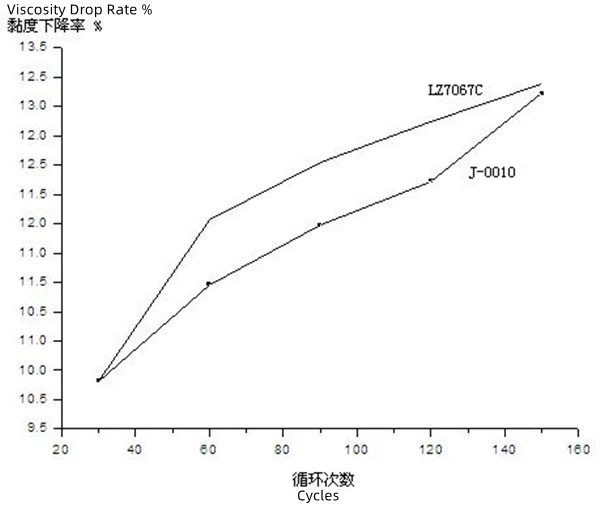
For more about the Viscosity Index Improver OCP J0010, please feel free to contact us.

Contract us to get the latest OCP VII price.


