
How to prevent the workpiece rust in the short term?
Leave a message
Metals are widely used as raw materials. Their excellent physical properties enable them to be widely applicable in various industries, such as industrial manufacturing, construction, transportation, and production. However, in the long term of using metal, it often occurs that metal rusts, which not only damages the metal itself but also affects the mechanical properties and structural integrity of the facility, leading to safety hazards and environmental pollution.
Nowadays, metal corrosion has become a global economic issue. According to statistics, the economic loss caused by corrosion worldwide each year accounts for about 3%-4% of GDP (about 2.5 trillion dollars), of which the loss caused by industrial corrosion accounts for more than 40% of all corrosion losses. Therefore, choosing suitable rust inhibitors and anti-rust agent additives to prevent rust can have a great influence in decreasing economic loss, extending metal workpiece service life, and protecting the environment.
The following picture shows the process of metal corrosion. It can be seen that metal corrosion is very harmful to metal, which seriously influences the service life of the metal.

What are the solutions to rust on metal workpieces?
The essence of metal rusting is the process in which metals undergo oxidation reactions with water and oxygen to form loose and porous iron oxide. The oxidation rate is related to the environment in which it is located, oxygen concentration, temperature, and the activity of the metal itself.
There are many kinds of anti-rust additives, mainly divided into 2 categories: inorganic rust inhibitors and organic antirust agent.
The most inorganc compounds prevent rust by forming insoluble passivation or reactive film layers on the metal. And the common inorganic rust inhibitors include sodium nitrite, potassium dichromate, borate, molybdate, tungstate, etc.
Organic rust inhibitors prevent rust by adsorbing onto the metal surface through chemical adsorption, thereby altering the metal surface state. Common used organic rust inhibitors include fatty acid soaps, carboxylic acids, sulfonates, amines, ammonium salts, amides, esters, and phosphate ester salts, etc.
In practical application, we prevent rust by applying anti-rust oil and water-soluble anti-rust agents.
In order to reduce economic loss, it's a common method to use water-based anti-rust liquid to protect metals. However, owing to problems of water-based anti-rust liquid, such as the poor rust prevention ability, slow drying of the rust prevention film, and poor adhesion to the coating layer after application, it cannot achieve the rust prevention effect of rust preventive oil.
Applying rust preventive oils has good performance in preventing corrosion, and it can adsorb and neutralize harmful substances to strengthen its protective effect. What's more, the cost of anti-rust oils is much lower than other rust preventive methods; therefore, it saves more when maintaining and changing oils.
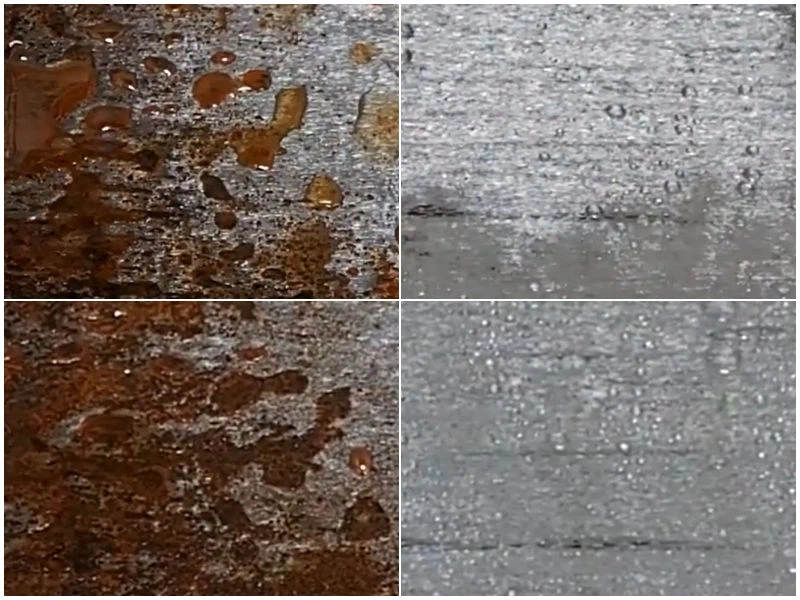
This picture shows the comparison before and after the use of rust inhibitors. It can be seen that after using rust-preventive additives, the rust on the metal surface is removed a lot.
What are the metal anti-rust additives that Chorus can provide?
The choice of anti-rust additives plays a crucial role in metal rust and corrosion. Otherwise, it will reduce the rust prevention ability of the rust inhibitor.
The anti-rust additive is composed of base oil, special preservatives, and other essential ingredients, in which base oil is most important and accounts for about 85%-95%.
But, merely applying base oil can only provide the most basic superficial protective effect and cannot completely and effectively prevent metal corrosion. Therefore, it's indispensable to add various rust preventive additives with different functions to the base oil to assist in rust prevention.
Chorus is a professional rust inhibitor additives supplier in China, dedicated to providing high-quality services, offering a wide range of anti-rust protective additives with different functions, including
- Rust-Preventive Chemicals;
- Rust-Preventive Package;
- Water-Soluble Rust-Preventive Additives;
- Copper, Aluminum, Zinc Corrosion Inhibitors;
- And Other Rust-Inhibitor Additives.
Multi-metal Corrosion Inhibitor Additive Chorus-9220
It's a special corrosion inhibitor additive for copper, aluminum, and zinc, which is suitable for formulating various water-based metal process fluids.
Barium-based liquid rust additive kit Chorus-7010
It is suitable for formulating metalworking rust prevention oils.
It is a cost-effective liquid anti-rust additive package based on barium sulfonate and fatty acids. And it's mainly used in metalworking anti-rust oils, whose salt spray performance can last for more than 50 hours.
Adding about 10% Chorus 7010 in base oil and other relevant additives to obtain professional anti-rust oil for metal processing makes the generation of anti-rust oil easy and fast.
Rust Inhibitor & Antiwear Additive Chorus-T3616----Application in Lubricating Oils and Metalworking Fluids
On the basis of rust prevention, T3616 also has good wear resistance, which can greatly improve the life of metal parts and reduce machine damage. It is widely used in engine oil, hydraulic oils, gear oils, and metalworking fluids.
Contact us and get a professional solution for metal workpiece rust prevention.